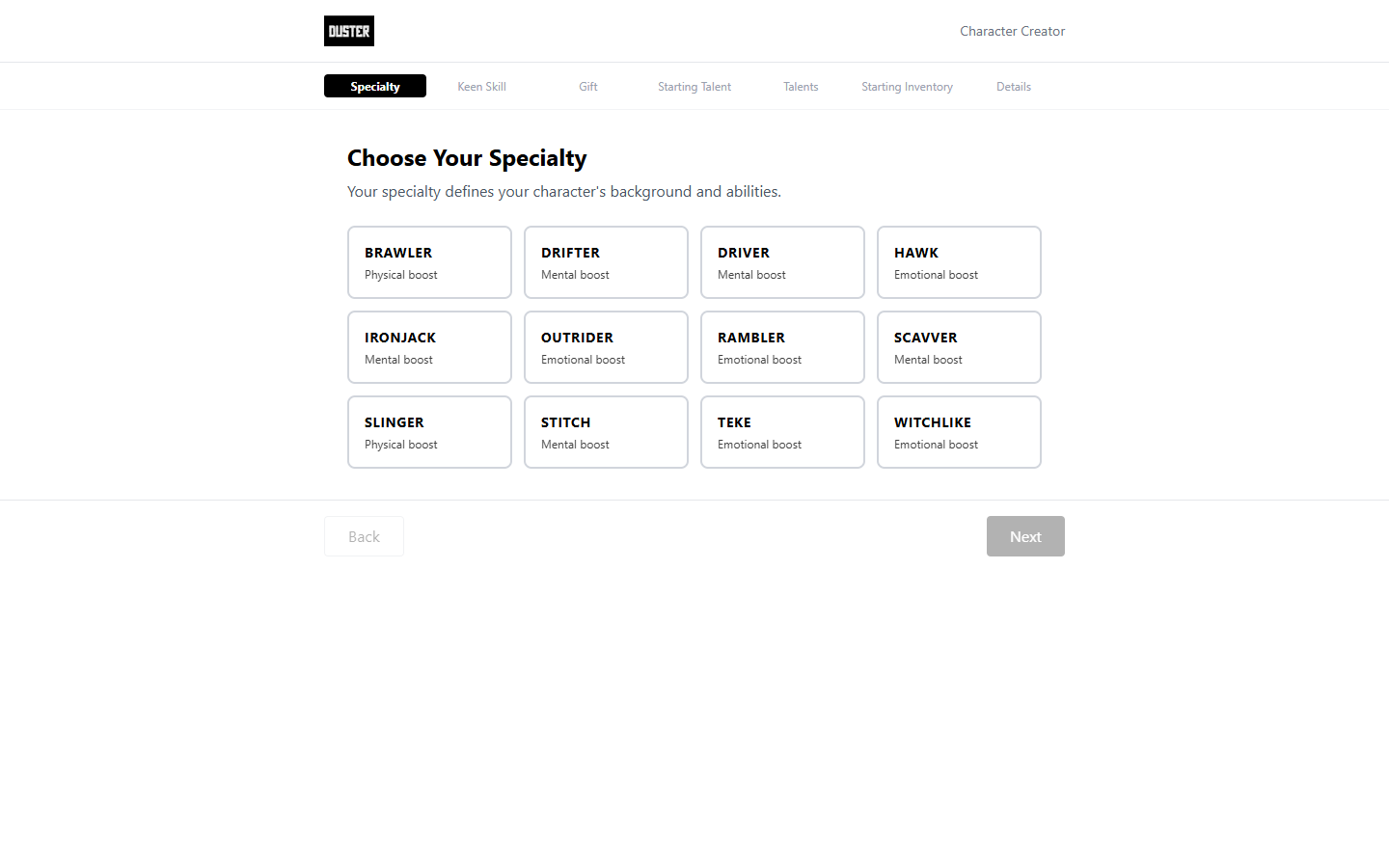
Big tabletop games solved character creation a while ago. Open D&D Beyond, answer a few questions, and you walk away with a finished, rules-legal character sheet. For an indie or small publisher, that kind of guided experience has felt out of reach — so character creation often lives in a convoluted spreadsheet players cross-reference against the rulebook, and the “sheet” at the end is a PDF they fill by hand.
It doesn’t have to be. A custom character creator is buildable for your game specifically — and you can own it outright.
What is a custom character creator?
A character creator is interactive, rules-aware software that walks a player through building a character step by step — choosing a class or specialty, spending points, picking talents and gear — while enforcing your system’s actual rules, then exports a print-ready character sheet that matches your published layout.
The key words are rules-aware and guided. It’s not a fillable PDF, and it’s not a generic sheet builder. It knows that picking one option closes off another, that a certain choice unlocks a certain ability, and that the end result has to be a legal character. Done well, players don’t just finish faster — they understand their options and get excited about the character they’re building.
Why build one for your game?
For a publisher, a creator earns its keep in a few concrete ways:
- Faster onboarding. New players get from “I bought the book” to “I’m ready to play” without a spreadsheet detour — the single biggest drop-off point for a crunchy system.
- Fewer rules questions. The tool enforces the rules, so players make fewer mistakes and ask fewer “wait, can I take this?” questions.
- A premium, on-brand experience. It wears your brand and lives at your URL — the polish big games are known for, applied to yours.
- An asset you own. No platform tax, no per-seat licensing, no walled garden. It’s yours to run and extend.
The fit isn’t universal: the value tracks with crunch. The more classes, ancestries, talents, and interacting choices your system has, the more a guided creator helps. Rules-light games get less from it — the friction is the value.
Build it, rent a platform, or hire a freelancer?
There are three common paths, and they’re genuinely different:
- VTT / platform builders (Roll20, Demiplane, and the like) host your game inside their product. Your tool wears their skin, lives behind their paywall, and follows their roadmap. Convenient, but not yours.
- Freelancer marketplaces mostly sell static, hand-designed PDF sheets — graphic design, not interactive rules-aware software. You’re left to spec, manage, and integrate.
- A bespoke build you own is the third path: software built for your system, in your brand, at your URL, that you keep. It’s the most work to commission and the most yours when it’s done.
The right choice depends on whether you want to rent the experience or own it.
What it takes to build one
Building a creator that’s actually faithful to your game comes down to a few moves:
- Map the system first. Before any screens, the full rule set and its validation get modeled, so every choice cascades correctly — exactly like the published game. This is the hard part, and skipping it is why generic tools never quite fit.
- Sequence it the way a player thinks. Big, identity-defining choices come first and cascade into the smaller ones that depend on them, so players feel oriented instead of overwhelmed.
- Nail the output. The exported sheet has to match your real character sheet — the artifact players actually use at the table.
- Hand it off. It ships on your site with documentation, so it’s yours to run without a developer on retainer.
Case study: Duster
We built exactly this for Occupied Hex’s Duster, a post-apocalyptic western RPG whose character creation had lived in a convoluted spreadsheet with no character sheet at the end. We replaced it with a guided, seven-step creator that exports a print-ready sheet — shipped to live playtesting.
In the publisher’s words: “Watson’s tool was clean and user-friendly and got literal oohs and aahs from my customers. He couldn’t be easier to work with and I was very impressed with the end result.” — Andrew, Occupied Hex Games.
How to get one for your game
If your players deserve a real character creator — and you’d rather own it than rent it — that’s what FOIL builds. See what we build for tabletop publishers, or read the full Duster case study.